Practical
Bangkok on a Budget
The biggest savings in Bangkok come from how you move and where you eat, not from skipping the sights. Here's where the money actually goes.
Updated
4 min read
How we research
In this guide ↓
Bangkok is one of the best-value big cities in the world to visit, but it's easy to spend more than you need to: on taxis stuck in traffic, on drinks in tourist areas and on tours for things you can do yourself. The biggest savings come from how you move around and where you eat, not from skipping the sights.
We don't publish a daily budget figure: it depends far too much on your accommodation and how you travel. Instead, here's where the money goes and how to keep it down. Prices below were checked in October 2026.
The short version
| Spend | Save |
|---|---|
| Taxis in rush hour | The BTS, MRT and river boats |
| Hotel restaurants and rooftop bars | Street food, markets and food courts |
| Tours for easy sights | Yaowarat, the Old Town temples and Ayutthaya independently |
| Several paid temples a day | One big paid sight, then free ones |
| Drinks in tourist areas | Convenience stores and local bars |
Getting around
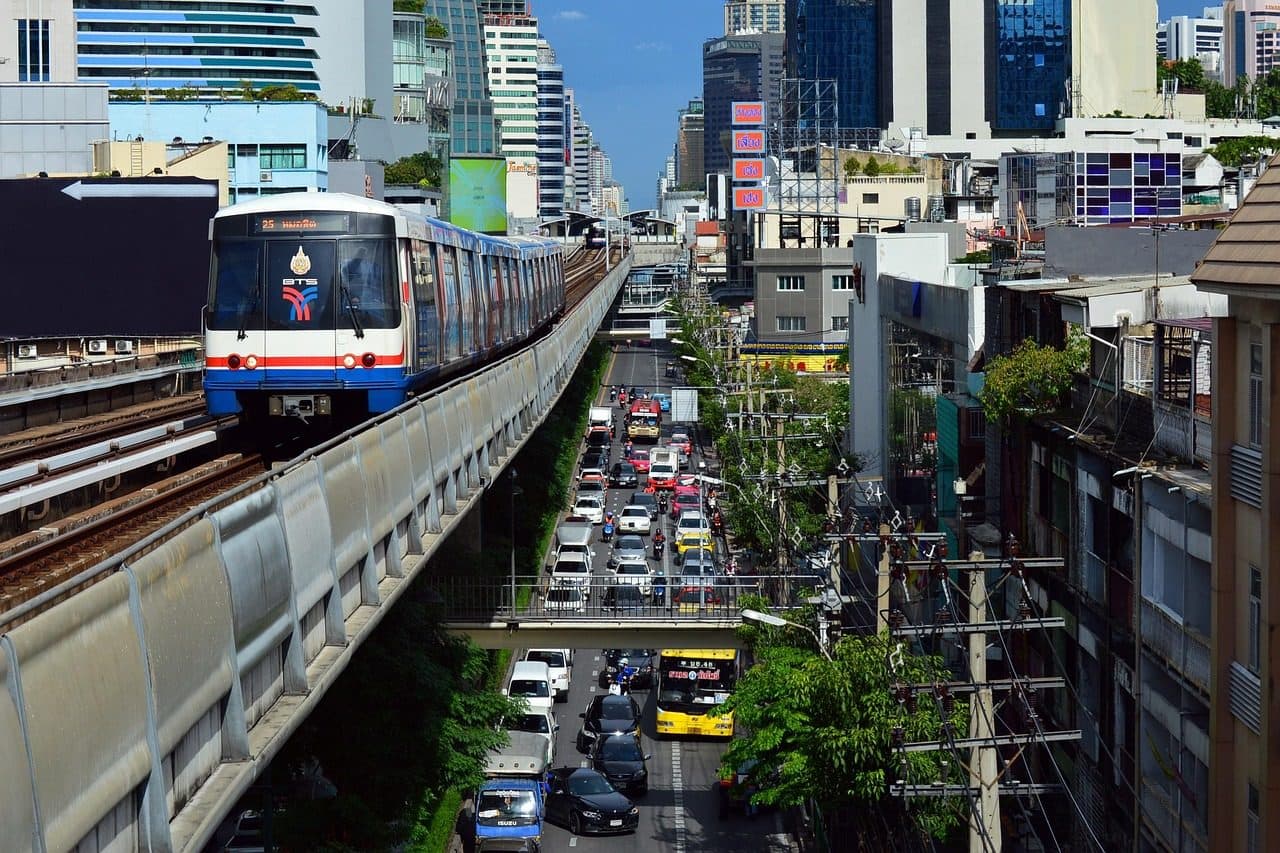
- Rail is the best value for most journeys, because it avoids traffic as well as costing little. MRT Blue Line fares are 17–44 THB, distance-based, from 3 July 2026 (Thai PBS). BTS fares are also distance-based. A plan for a flat 20 THB fare on all lines was dropped in June 2026; a unified BTS fare structure of 17–45 THB is planned from January 2027 (Thairath). See the BTS and MRT guide.
- The BTS and MRT charge separately, so a route that changes between them costs two fares. Plan longer trips to stay on one system where you can.
- The Chao Phraya Express Boat is cheap, scenic and often faster than a taxi along the river. The orange-flag boat is the everyday option; the tourist boat costs more. See the Chao Phraya River.
- Use Grab or Bolt rather than flagging taxis in tourist areas, so the price is fixed before you go. Avoid tuk-tuks for anything other than the experience: they usually cost more than a taxi.
- From the airport, the Airport Rail Link costs up to 45 THB to Phaya Thai. See airport to city.
Eating
- Street food and markets are the cheapest way to eat well, and often the best. See Bangkok street food.
- Mall food courts — Siam Paragon, MBK, Terminal 21 and others — many work by loading a prepaid card at a counter (unused credit is refunded) and paying with it at each stall. Clean, air-conditioned and good value.
- Convenience stores such as 7-Eleven for water, breakfast and snacks.
- Office districts at lunch are among the cheapest places to eat a proper meal on weekdays.
Sightseeing
The big paid sights are the main fixed cost. For foreign visitors, the Grand Palace is 500 THB, Wat Pho 300 THB and Wat Arun 200 THB (checked October 2026; see each page for the source). Choose the ones you care about most.
Some of the best things in Bangkok are free:
- Lumphini Park at dawn and Benjakitti Forest Park at sunset
- The Bangkok Art and Culture Centre, a free contemporary art centre
- The Erawan Shrine and the other shrines around Ratchaprasong
- Yaowarat after dark, and walking Talat Noi and Sampeng Lane
- Markets — Chatuchak, Jodd Fairs and Pak Khlong Talat
- The river view of Wat Arun from Tha Tien at sunset
Where to stay
Value areas with good transport: Silom, the area around Phaya Thai and Victory Monument, Ari and lower Sukhumvit. Khao San Road has the cheapest beds but is far from the rail network. See where to stay.
Money
- ATM fees are the hidden cost. Thai banks charge foreign cards a flat fee of a couple of hundred baht per withdrawal, on top of your own bank's charges. Withdraw larger amounts less often.
- Decline currency conversion when an ATM or card machine offers to charge you in your home currency; pay in baht.
- Cash is still needed for street food, markets and small shops. See the money section of the travel guide.
Time it right
- Go to rooftop bars at opening or for a single drink at sunset, rather than spending an evening there; see rooftop bars.
- Eat your big meal at lunch. Many restaurants that are expensive at night serve cheaper lunch sets.
- Travel outside rush hour (roughly 7–9:30am and 4:30–8pm): taxi fares rise with time in traffic, and ride-hailing prices surge.
Don't save on
- Travel insurance.
- Sun protection and water in the hot season.
- A licensed operator for anything involving boats or transport outside the city.
- A data eSIM — it makes Grab, maps and translation possible. See Bangkok eSIM.
Avoid the traps
Most overspending comes from scams: the "Grand Palace is closed" approach, tuk-tuk detours to gem shops, and unmetered taxis. See Bangkok scams.
- Bangkok Travel GuideThe practical layer under every Bangkok trip: how to arrive, how to move, how to pay and how not to get caught out. Entry rules link to official sources, because they change.
- Where to Stay in BangkokLocation matters more in Bangkok than in most cities, because traffic punishes the wrong choice. Start with how you want to spend your evenings and how close you need to be to the BTS or MRT.
where to next?
- Bangkok Travel GuideThe practical layer under every Bangkok trip: how to arrive, how to move, how to pay and how not to get caught out. Entry rules link to official sources, because they change.
- Bangkok BTS and MRT GuideBangkok's trains are fast, cool and clean, and they are the single best way to avoid the traffic. This is everything a visitor needs to use them confidently.
- Bangkok Scams to Know AboutBangkok is a safe city, but it has a handful of well-rehearsed scams aimed at first-time visitors. Knowing them in advance is almost all the protection you need.